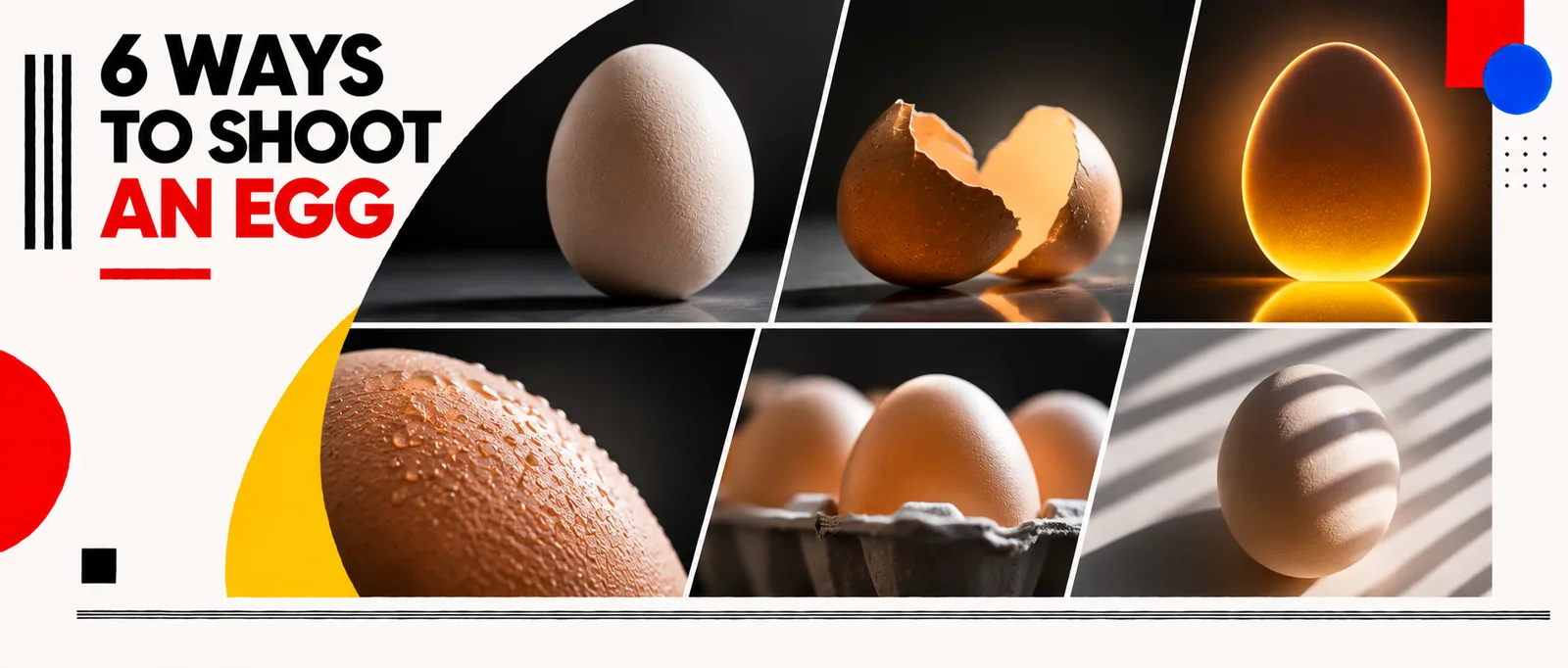
Assignment 02 | 6 Ways to Shoot an Egg
6 Ways to Shoot an Egg
Six completely different photographs of one simple object, built across the semester.
START HEREOpen your one-sheetPrint it or keep it open while you work.Open ↗6
finished photos
2
check-ins along the way
JPG
edited in Lightroom
Unit
project, never dropped
The one rule
Every photo must be completely different from the others. A new angle in the same light is not a new photo.
The goal
The egg is the subject. Keep the background and the setup clean, so nothing in the frame competes with it.
Step by step
Read the 6 Ways to Shoot an Egg lesson page first. The red lines are where most students lose points.
01
Keep shooting all semester
A few new looks between every check-in.
• Rough guide: about 2 by check-in 1 (Week 5), about 4 by check-in 2 (Week 11), all 6 at the end.
• Bring everything finished to each check-in, even the ones you are not sure about.
Watch out: Six photos in the last week will look like one afternoon. Start early and keep going.
02
Change the light every time
Light, form and shadow.
• Hard light, soft light, side light, backlight, window light, a lamp, a flashlight.
• Let the shadow, the shape and the texture of the egg change with the light.
Watch out: Same light, new angle is the same photo. Change the light first.
03
Keep it clean
Nothing competes with the egg.
• Plain backgrounds and simple surfaces.
• Color, texture and composition chosen on purpose.
Watch out: Mail, cables, the edge of the table, a busy kitchen. If you did not choose it, remove it.
04
Edit in Lightroom
Then export as JPGs.
• Finish every photo in Lightroom and export a JPG.
• Keep all your Egg photos in one "Egg" folder, finals in a "Finals" subfolder.
Watch out: No RAW files and no unedited frames. Only finished JPGs are graded.
05
Write your log
Two sentences per photo.
• One sentence about the light and the layout.
• One sentence about your main theme or idea.
• Example: Hard side light from a desk lamp, the egg low in the frame with a long shadow. The idea is how small the egg looks next to its own shadow.
06
Choose the order and submit
The series as one body of work.
• Put the six in the order you want them seen. Number the files 01 to 06.
• Upload the six JPGs and your log here.
Watch out: Count the files before you submit. Five is not six.
Check before you submit